Class 7: Linear Regression
Contents
Covariance and Correlation
Variance
Recall the variance of a random variable X, denoted var(X) or σ2, is the expected value (probability-weighted average) of the squared deviations of Xi from it’s mean (or expected value) ˉX or E(X).Note there will be a different in notation depending on whether we refer to a population (e.g. μX) or to a sample (e.g. ˉX). As the overwhelming majority of cases we will deal with samples, I will use sample notation for means).
σ2X=E(X−E(X))=n∑i=1(Xi−ˉX)2pi
Note if all possible values of Xi are equally likely (or we don’t know the probabilities), we can write variance as a simple average of squared deviations from the mean:
σ2X=1nn∑i=1(Xi−ˉX)2
Variance has some useful properties:
Property 1: The variance of a constant is 0
var(c)=0 iff P(X=c)=1
If a random variable takes the same value (e.g. 2) with probability 1.00, E(2)=2, so the average squared deviation from the mean is 0, because there are never any values other than 2.
Property 2: The variance is unchanged for a random variable plus/minus a constant
var(X±c)
Since the variance of a constant is 0.
Property 3: The variance of a scaled random variable is scaled by the square of the coefficient
var(aX)=a2var(X)
Property 4: The variance of a linear transformation of a random variable is scaled by the square of the coefficient
var(aX+b)=a2var(X)
Covariance
For two random variables, X and Y, we can measure their covariance (denoted cov(X,Y) or σX,Y)Again, to be technically correct, σX,Y refers to populations, sX,Y refers to samples, in line with population vs. sample variance and standard deviation. Recall also that sample estimates of variance and standard deviation divide by n−1, rather than n. In large sample sizes, this difference is negligible.
to quantify how they vary together. A good way to think about this is: when X is above its mean, would we expect Y to also be above its mean (and covary positively), or below its mean (and covary negatively). Remember, this is describing the joint probability distribution for two random variables.
σX,Y=E[(X−ˉX)(Y−ˉY)]
Again, in the case of equally probable values for both X and Y, covariance is sometimes written:
σX,Y=1Nn∑i=1(X−ˉX)(Y−ˉY)
Covariance also has a number of useful properties:
Property 1: The covariance of a random variable X and a constant c is 0
cov(X,c)=0
Property 2: The covariance of a random variable and itself is the variable’s variance
cov(X,X)=var(X)σX,X=σ2X
Property 3: The covariance of a two random variables X and Y each scaled by a constant a and b is the product of the covariance and the constants
cov(aX,bY)=a×b×cov(X,Y)
Property 4: If two random variables are independent, their covariance is 0
cov(X,Y)=0 iff X and Y are independent:E(XY)=E(X)×E(Y)
Correlation
Covariance, like variance, is often cumbersome, and the numerical value of the covariance of two random variables does not really mean much. It is often convenient to normalize the covariance to a decimal between −1 and 1. We do this by dividing by the product of the standard deviations of X and Y. This is known as the correlation coefficient between X and Y, denoted corr(X,Y) or ρX,Y (for populations) or rX,Y (for samples):
rX,Y=cov(X,Y)sd(X)sd(Y)=E[(X−ˉX)(Y−ˉY)]√E[X−ˉX]√E[Y−ˉY]=σX,YσXσY
Note this also means that covariance is the product of the standard deviation of X and Y and their correlation coefficient:
σX,Y=rX,YσXσYcov(X,Y)=corr(X,Y)×sd(X)×sd(Y)
Another way to reach the (sample) correlation coefficient is by finding the average joint Z-score of each pair of (Xi,Yi):
rX,Y=1nn∑i=1(Xi−ˉX)(Yi−ˉY))sXsYDefinition of sample correlation=1nn∑i=1(Xi−ˉXsX)(Yi−ˉYsY)Breaking into separate sums=1nn∑i=1(ZX)(ZY)Recognize each sum is the z-score for that r.v.
Correlation has some useful properties that should be familiar to you:
- Correlation is between −1 and 1
- A correlation of -1 is a downward sloping straight line
- A correlation of 1 is an upward sloping straight line
- A correlation of 0 implies no relationship
Calculating Correlation Example
We can calculate the correlation of a simple data set (of 4 observations) using R to show how correlation is calculated. We will use the Z-score method. Begin with a simple set of data in (Xi,Yi) points:
(1,1),(2,2),(3,4),(4,9)
library(ggplot2)

corr.example<-data.frame(x=c(1,2,3,4),
                         y=c(1,2,4,9))
ggplot(corr.example,aes(x=x,y=y))+geom_point()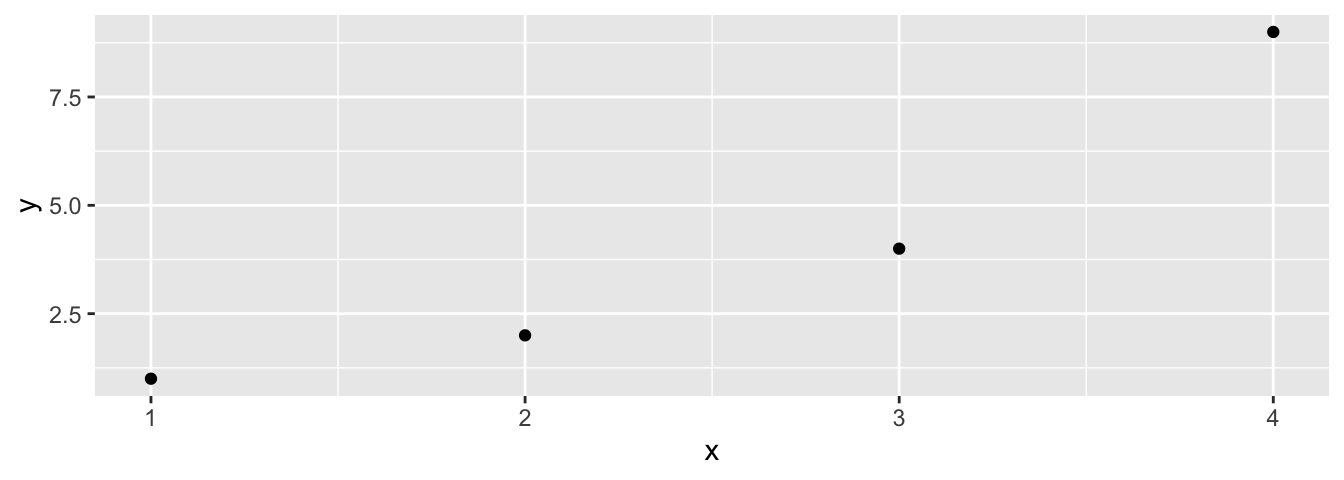
## [1] 2.5## [1] 4## [1] 1.290994## [1] 3.559026#take z score of x,y for each pair and multiply them
corr.example$z.product<-(((corr.example$x-2.5)/1.291)*
((corr.example$y-4)/3.559))
corr.example ## x y z.product
## 1 1 1 0.9793959
## 2 2 2 0.2176435
## 3 3 4 0.0000000
## 4 4 9 1.6323265## [1] 0.943122## [1] 0.9431191## [1] 4.333333